

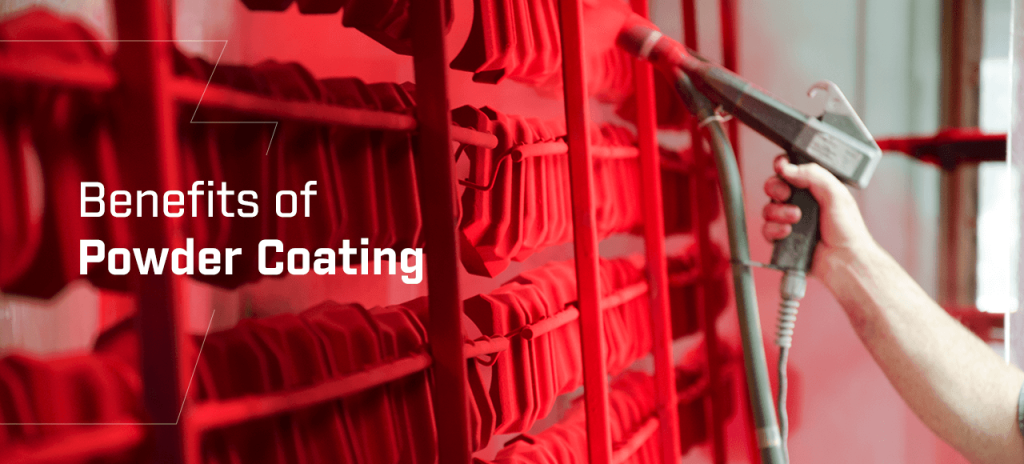
Powder coating helps to improve corrosion resistance, extend the coating lifespan and support efficient production. Production leaders must find a quality coating process that protects metal components and meets tight project timelines.
Explore the benefits of powder coating and why manufacturers choose it for durability, operational efficiency and reduced project costs.
What Are the Advantages of Powder Coating?
There are several advantages to powder coating that make it a popular choice for manufacturers, including durability, longevity, time and money savings, and eco-friendliness:
- Durability: Powder coating provides robust durability and offers resistance to chipping, fading, scratching and general wear. The coating features high UV-resistant formulations and rust resistance for outdoor applications.
- Longevity: Powder-coated parts are typically easy to maintain due to their durability. The thermal bonding process creates a robust coat resistant to a range of weather and environmental conditions.
- Time and money savings: Powder coating offers significant long-term time and money savings. Its quick application process enables high throughput and lower labor costs than other methods.
- Eco-friendliness: Powder coating is an environmentally friendly way of finishing metal parts. A key benefit is that these coatings emit virtually no volatile organic compounds (VOCs), which are harmful to the environment and human health.
Is Your Current Finish Costing You More Money?
A poor finish can increase maintenance costs and contribute to premature coating failures:
- Hidden costs add up: Coating issues may lead to warranty claims, rework expenses, replacement parts and production delays. These issues affect both immediate budgets and the ability to build long-term customer relationships.
- Multi-coat systems slow production: Liquid finishing systems often need multiple application stages and extended curing times. With each step, you’re likely increasing production time and labor demands.
- Edges remain vulnerable: Liquid coatings become thinner around edges and corners during drying. These areas are more susceptible to reduced protection than flat surfaces, creating weak points where corrosion can build up.
The annual global cost of corrosion typically exceeds $2.5 trillion. Introducing corrosion control practices could save up to approximately 35% of those costs.
How Does Powder Coating Improve Metal Durability?
Powder coating improves the durability of metal surfaces by creating a protective finish through an electrostatic application process, followed by controlled heat curing in industrial ovens. This process follows key stages of surface preparation, powder deposition and precision curing.
The final barrier aims to protect metal components from corrosion, impact and environmental exposure. Manufacturers can learn how powder coating works and check whether this finishing method matches their production requirements.
Corrosion Resistance
Applying powder coating protects metal surfaces from moisture, oxidation, chemicals and daily wear. The cured coating creates a barrier that generally resists common industrial chemicals, oils and cleaning agents.
Using a robust powder coating can also safeguard against early material degradation. Properly selected industrial powder coating systems offer corrosion protection when the coating system is suitable for the environment.
The finish resists scratches and impacts during normal service. Coating performance depends on proper surface preparation rather than the powder alone.
Alongside the coating, the pretreatment process is a crucial factor in determining durability. Pretreatment includes cleaning, degreasing, removing impurities, drying and priming surfaces for better application. If corrosion appears on powder-coated metal parts, it may indicate a substrate or pretreatment issue rather than a coating failure.
Superior Edge Coverage
Powder coating can provide more consistent coverage around edges and corners compared to many liquid paint systems. Edges and corners are the most vulnerable areas for corrosion on metal components.
Liquid coatings may thin out around edges during drying. The powder deposition process preserves reliable coverage around edges and tricky areas.
How Powder Coating Can Lower Total Ownership Costs
Powder coating can reduce total ownership costs through efficient application techniques, improved material use and longer-lasting coating performance. Manufacturers benefit from lower material waste and faster production cycles:
- Production moves faster: Easier application and curing methods will likely speed up production rates. With single-coat powder, you don’t wait as long between paint layers.
- Material waste decreases: Powder coating achieves 60%-70% transfer efficiency on the first pass. Efficient powder coating systems, including those with powder recovery, can use up to 98% of the material. However, liquid systems waste 40%-60% of the material they spray. Reusing excess spray can reduce waste and lower material costs.
- Long-term value improves: Durable finishes can reduce maintenance schedules, replacement frequency and warranty-related costs. Using sustainable coating practices supports both environmental responsibility and project finances.
What Affects Powder Coating Performance?
Powder coating performance typically depends on proper surface preparation, pretreatment, application, curing and quality control. Below are the other key factors to consider:
- Surface prep matters: Cleaning removes oils, dirt and other contaminants before coating. Contaminated surfaces can prevent proper coating adhesion.
- Pretreatment improves adhesion: Chemical pretreatment forms a conversion coating that bonds the powder to the metal surface and enhances durability. This step directly affects corrosion resistance.
- Curing control matters: Precision curing ovens help to maintain the temperature and time requirements needed for proper powder flow and cross-linking. Inconsistent curing can create weak points in the coating finish.
- Quality inspection verifies specs: Post-cure inspection reviews the coating thickness, adhesion and finish quality. Components that fail the inspection receive rework before shipment.
- Formulation matters: Different powder formulations provide different performance characteristics. Outdoor applications generally require UV-resistant qualities, while indoor components may use standard finishes.
Why Your Powder Coating Partner Matters
Here’s why Keystone Koating is the right choice for your operation:
- Eight-stage pretreatment: Keystone Koating’s pretreatment process supports consistent coating quality across high-volume production. This process uses chrome-free zirconium sealing with advanced silane technology. Multiple rinse stages remove contaminants and prepare metal components for better coating adhesion.
- High-volume capacity: Our high-volume powder coating capacity handles production runs of various sizes with reliable turnaround times. Manufacturers can benefit from start-to-finish capabilities that include blasting, pretreatment, coating application, powder coating quality assurance and curing.
- Performance warranty: KEYCOAT20 provides a 20-year warranty on coating performance. We are confident in the pretreatment systems and application processes for long-lasting finishes.
- Proven experience: We offer more than 30 years of powder coating experience, delivering high-quality results for purchasers and production leaders who require consistently dependable finishes.
Achieve a Quality Finish for Your Components With Keystone Koating
The right powder coating partner offers consistent results across high-volume production runs. At Keystone Koating, we provide the pretreatment systems, production capacity and quality control that manufacturers need for excellent finishes.
Submit your specifications, production files and other project information. We aim to provide you with a quote within 48 hours. Get your powder coating quote today.